-
Fakebook: homepage. Create educational games and quizzes at classtools.net
-
The People Behind Teaching Channel, Committed to Showcasing Videos of Inspiring Teachers
Teaching Channel is committed to showcasing effective and inspiring teaching in public schools across America. Our mission is to revolutionize how teachers learn, connect, and inspire each other to improve the outcomes for all students in America. In order to accomplish this mission, we have three simple goals:
-
100+ Google Tricks That Will Save You Time in School – Eternal Code
These search tricks can save you time when researching online for your next project or just to find out what time it is across the world, so start using these right away.
Saturday, January 28, 2012
Links (weekly)

Bookmarks (weekly)
-
Fakebook: homepage. Create educational games and quizzes at classtools.net
-
The People Behind Teaching Channel, Committed to Showcasing Videos of Inspiring Teachers
Teaching Channel is committed to showcasing effective and inspiring teaching in public schools across America. Our mission is to revolutionize how teachers learn, connect, and inspire each other to improve the outcomes for all students in America. In order to accomplish this mission, we have three simple goals:
-
100+ Google Tricks That Will Save You Time in School – Eternal Code
These search tricks can save you time when researching online for your next project or just to find out what time it is across the world, so start using these right away.
Friday, January 27, 2012
Dear Frustrated in Love: Read a Classic
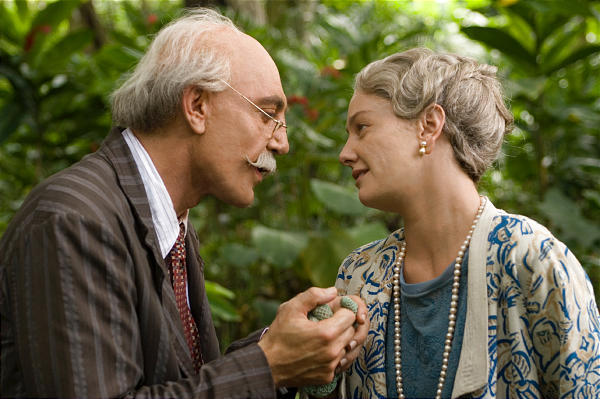
Bardem, Mezzogiorno In "Love in the Time of Cholera"
Today I’ll let an article in The Daily Beast cover for today’s post. Whenever I see headlines announcing that literature can change our lives, I rejoice that people are rediscovering what was once taken for granted. Maura Kelly offers up some gems in a column entitled “Virgil, Jane Austen and Other Authors Can Teach Us About Love.”
For instance, check out her conclusion about Aeneas leaving Dido in order to found Rome, leading her to commit suicide:
After Jupiter, head of the gods, finds out about Aeneas’s amorous dilly-dallying, he sends his heavy, Mercury, down to earth to pressure the Trojan to get moving. When Aeneas breaks the news to Dido that he has to be on his way (after first trying to slink off without discussing it, the coward), he says he cares about her immensely, but can’t ignore his enormous life goal. As he puts it, “I sail for Italy not of my own free will.”
When Virgil was writing, people really believed that gods controlled people’s fates, and engineered the world so that humans would do certain things (like fall in love, or not, and start cities). But in our time, the genes and life experiences that help to determine our personalities can be just as powerful and determining as the gods were once thought to be. So what we moderns should learn from the sad tale of Aeneas and Dido is that it’s wise not to take it too personally—the way the queen did—if a person with big ideas about his (or her) destiny says he (or she) isn’t up for a relationship. Plenty of men (and women) feel called to certain paths just as much as Aeneas felt called by Jupiter—and as they march toward their futures, they often mistreat regal lovers, leaving broken hearts in their paths. If someone who looks like a demigod dumps you, remember: He’s not necessarily being a douchebag of his own free will. No, some people can’t help sailing—or slithering—on. To protect yourself in these kinds of situations, have a discussion pretty early on about what direction the relationship is going in; understand how you fit in, if at all, to his five-year-plan. If only Dido had done that, she’d have figured out a lot sooner—well before she let herself get tragically head over heels—that Aeneas was in no position to commit.
Kelly also looks at Sense and Sensibility and Love in the Time of Cholera. In the first she compliments Austen for seeing the potential in the Brandon-Marianne marriage. Although Marianne doesn’t have strong feelings of attachment at first, ultimately she is won over by his “strong esteem and lively friendship.” Kelly points out that, according to recent research, these elements have as much chance of leading to a happy marriage as relationships that begin with a special spark.
Kelly sees Gabriel Garcia Marquez’s book as strong warning against e-mail dating. She quotes the passage where Fermina, after a length secret correspondence with Florentino, she actually sees him:
Instead of the commotion of love, she felt the abyss of disenchantment. In an instant the magnitude of her own mistake was revealed to her, and she asked herself, appalled, how she could have nurtured such a chimera in her heart for so long and with so much ferocity.
Kelly extracts from this book the following piece of advice:
Keep the correspondence to a minimum (send no more than five notes, have no more than one phone call) before you’ve sussed out the attraction in person.
Kelly omits to mention, however, that Fermina and Florentino end up engaging in one of literature’s most romantic geriatric relationships. Another good lesson to take away from the book is that romance isn’t the exclusive property of the young.
The article concludes with Kelly counseling us,
while I do recommend you go easy on the emailing if you want to find love, I can’t encourage you enough to keep reading—a great use of your time, and a great help for your heart.
Not that readers of this blog need reminding.

Choose, GOP: Rich Mobster or Sleazy Pimp

Robert de Niro in "Casino"
Film Friday
In today’s post I share a smart cinema parallel (from Jonathan Chait of New York Magazine) between the Mitt Romney-Newt Gingrich battle and a Martin Scorsese film. And then I promise to leave campaign politics for a while.
Here’s Chait:
The Republican primary battle has come to resemble the love triangle in the movie Casino. The GOP electorate is Sharon Stone, torn between wealthy, calculating casino boss Robert DeNiro, whom she recognizes it is in her interest to marry, and James Woods, the sleazy pimp ex-boyfriend she can’t quite leave behind. She keeps rebuffing his marriage proposals, insisting she’s not in love with him, but he’s undeterred. “I’m realistic. I can accept that,” he says. “But, you know, what is… What is love anyway? It’s a — it’s a mutual respect.”
Chait notes the resemblance with Romney, who he says is “accepting and rational about the voters’ lack of true feelings for him,” even though he can’t understand why anyone would fall for a sleazebag like Gingrich:
Asked when he thought his party would fall in love with him, [Romney] said: “I think the Republican Party will fall in love with our nominee.”
To which Chait sarcastically replies, “When you have that base of respect, those feelings will grow in time. Right?”
Chait doesn’t mention how the film’s ending resembles the “take no prisoners” tenor the primary has taken. In Casino, the mob’s casino operation crumbles from the infighting.
But Chait does use the DeNiro-Stone marriage to predict the future of a Romney-GOP relationship:
Ultimately, Romney’s money will probably carry the day – either in Florida or sometime after. But the marriage will end in screaming and tears.

Quia - All Roman Numerals
Quia - All Roman Numerals
Sunday, January 22, 2012
The Adjustment Bureau and Macbeth
I was watching "The Adjustment Bureau" for the first time last night when it dawned on me that there are significant correlations to Macbeth in the movie. I'm wondering if my AP students, having recently read the play, will pick up on them. Let's see!